decompose the vector / you’re not in a quantum-entangled space.
I was on a call with my prev manager, let’s just call him Peter Pan, trying to explain why I still hadn’t picked a direction. Stay in the field I know, go all in on a new one, or take some time off. He delivered his answer in the nerdiest possible way, which is exactly why it stuck. It’s the most useful thing anyone’s said to me in months.
But before he got there, he made me explain why I’d done nothing at all.
What follows is most of what he said, and the parts I’ve decided to actually keep. Consider it a letter to myself with the receipts left in. If you’re somewhere between two versions of your career and can’t tell whether you’re figuring or hiding, some of this might be for you too.
why wasn’t it pinned
Back in the spring, I was on fire about something new, a different field, messier and earlier and further out on the frontier than the one I’d spent years in. I had a plan. Interview founders. Start a podcast. Put myself at the front of a conversation almost nobody was leading yet. Peter Pan remembers this vividly, because he was the one on the other end going go, go, go.
And then I just… didn’t.
Life happened. But when I offered that up as the explanation, Peter Pan did the thing good managers do. He refused the excuse while being kind about it.
“If you were really in it,” he said, “it would have happened. But that’s not what happened. It just fell out of your head. So the question isn’t what got in the way. It’s why wasn’t it pinned.”
That landed like a slap, because it’s the kind of question you can’t wriggle out of. If a thing is truly yours, you don’t have to protect it from a busy month. It survives one.
The lesson I’m keeping → interest is not a plan, and enthusiasm is not commitment. The only proof that something is yours is that it stays pinned when it stops being fun.
decompose the vector
Now the fear underneath all of it, the real reason the new direction kept “falling out of my head.”
Going all in on a new field means spending down the identity I built in the old one. Years of proof. A name people recognize. An inbox that still lights up with opportunities in the world I came from. Walk toward the new thing, and if it doesn’t work, I’ve burned something I can’t easily rebuild. That fear is quiet and it’s strong, and it dresses up as prudence.
Here’s the idea behind Peter Pan’s answer.
Everything you’re proud of is one big vector, and the instinct is to treat the whole thing as domain specific, as if it only pays out inside the field you earned it in. But break it into components and most of it has nothing to do with the domain. Knowing how to talk to founders. Knowing how to run an interview so the person feels seen rather than interrogated. Knowing how to build a narrative, find the right people, sit at the top of a distribution chain instead of the bottom. Those are general purpose axes. They point wherever you aim them.
“If you told me you were a specialist in Byzantine fault tolerance and now you want to do the new thing,” he said, “I’d tell you 97% of that is gone. But that’s not you. Decompose your vector and you’ll find 90% of it is reusable and 10% is domain specific. You’re terrified of losing the 10%.”
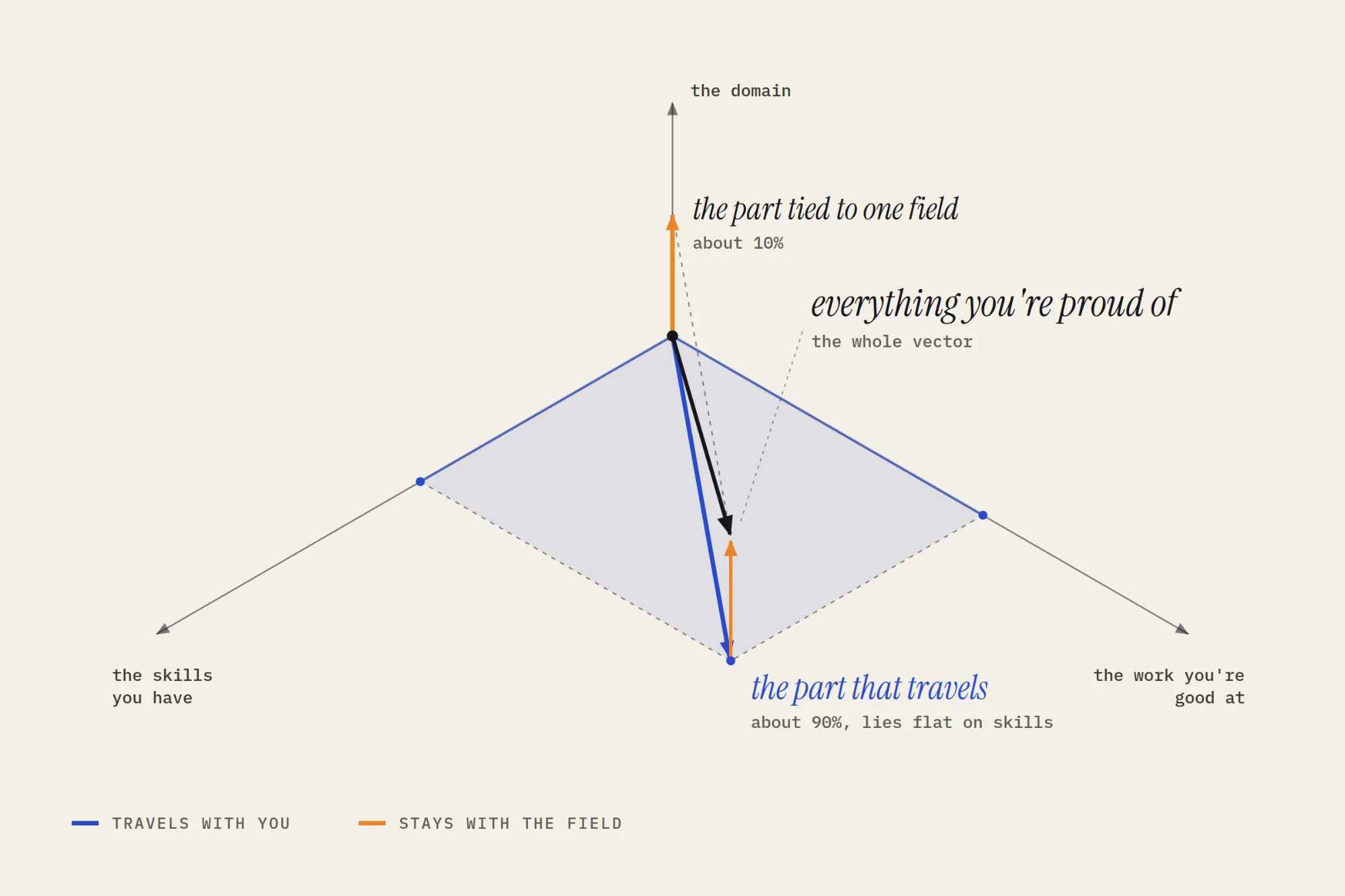
That reframed the entire fear. The domain is a small coordinate. The capabilities are the big ones. Loss aversion had me guarding the 10% so hard I couldn’t see that the other 90% travels with me regardless of where I go.
The lesson I’m keeping → your track record is mostly portable. Audit what you’re proud of and ask how much of it you’d keep in a completely different field. For most people who do skill based work, the number is uncomfortably high, and that’s the good news.
the gap is shaped like the thing you’re already good at
This is where it stops being therapy and turns into a plan.
The new field has a gap shaped almost exactly like the thing my vector is good at. It’s full of people who spent their careers heads down, who never had to explain themselves to the outside world and now suddenly do. Almost nobody is doing the connective, narrative, distribution work that already exists, fully mature and deeply competitive, in the field I came from. There’s an open slot for the neutral third party, unaffiliated with any of the giants, so everyone will actually talk to you. You interview them. You map the landscape. You become the person people trust to make sense of a field moving too fast for anyone to trust the raw feed.
I almost talked myself out of it with a very reasonable objection. How do you even map a field this young? There’s no shared scoreboard, no clean metrics, none of the obvious data points a mature industry gives you. Do you rank people by output? By vibes? It felt unstartable.
Peter Pan’s answer was a coffee shop.
Ask me, from my armchair, what problems a coffee shop owner has, and I’ll guess the obvious stuff. Bean supply, cleaning tables, foot traffic. All plausible, all mostly wrong. He knows this because a friend of his actually runs a chain, and the real problems turned out to be things I’d never have generated in an hour of guessing. Staff who simply don’t show up to open. Training that’s too hard, so the drinks come out wrong. You cannot brainstorm your way to the real challenges. You discover them by talking to the people who have them.
And here’s what makes this doable. People hate answering questions. They love correcting. Put a half right map in front of an expert and they’ll fall over themselves to fix it. The blank page version, “tell me everything about your field,” gets you nothing. The wrong but specific version, “here’s how I think this field ranks, tell me why I’m an idiot,” gets you everything. You don’t need the perfect framework to start. You need one good enough to provoke the correction. The corrections are the map.
The lesson I’m keeping → you can’t theorize your way into knowing a field’s real problems, and you don’t have to. Ship a wrong but specific first draft and let the experts fix it in public. That’s not a shortcut around the work. It is the work.
when content is infinite, trust becomes the product
There’s a deeper reason this “trusted third party” slot matters right now, and it’s the part I keep thinking about after the call.
It used to be that writing something good was itself the moat. There was a quality bar and a throughput limit. Being good took time, and time was scarce. That’s over. Anyone can now generate infinite plausible content, which means the signal that used to separate good from bad has been flooded past the point of usefulness.
So the evaluation moves up a level. People stop asking “is this good” and start asking “whom do I trust,” and then they consume whatever that person points them toward. In a world drowning in output, the scarce thing is a trustworthy filter. Being that filter is a real, defensible position, and it gets claimed early, in the window before a field has decided who its trusted voices are.
That window has a clock on it. The oldest rule in distribution is that someone gets there first, and if they’re good enough, second place is very far behind. It is dramatically easier to be first by a few months than to be second at any point after. The slot in the new field is open now. It will not be open forever. And I have been sitting on my hands, guarding a 10%.
The lesson I’m keeping → when quality gets commoditized, trust becomes the product, and trust is a land grab. If you can see an open slot at the top of a distribution chain, the cost of waiting is not zero. It’s the slot.
you’re not in a quantum-entangled space
Then we got to the actual decision, and this is where I embarrassed myself in a way worth writing down.
Facing three paths, my instinct was to not choose. To keep a little of each. And because I can’t help myself, I described this to Peter Pan as a probability distribution. “Can’t I just put mass on all three? Weight them?”
He let me finish and said, “You’re not in a quantum-entangled space. You have to collapse it.”
You can hold a distribution in your head, softmax it, keep it normalized, feel very sophisticated about your uncertainty. But you don’t live in the distribution. You live in one branch. You wake up on one of the days. A third here, a third there, a third rest isn’t a portfolio. It’s the exact configuration where nothing happens, which is precisely the state I’d been stuck in for months. Dressing it in math doesn’t make it a strategy. It just makes the paralysis look intentional.
Not doing anything is also an action. Kicking the can down the road is not the absence of a decision. It’s a decision, made passively, to stay exactly where you are.
This is why people talk about burning the boats. Not because destruction is virtuous, but because a retreat you keep available is a retreat you’ll eventually take. (Peter Pan was quick to clarify that burning the boats does not mean torching your actual bridges. You don’t send the scorched earth email to the door you’re not walking through. You just stop treating “I could always go back” as a browser tab you keep refreshing.)
The lesson I’m keeping → you can’t hedge your way through a fork. At some point you have to collapse the distribution and live in one branch. Optionality feels like freedom right up until it’s the reason nothing moves.
the machinery of actually deciding
Peter Pan wouldn’t tell me which door to pick, on purpose. “If it comes from me, it won’t set roots,” he said. “Two years from now you’ll say you only did this because I told you to, and you’ll use that as permission to flip.” So instead he handed me the machinery, and I’m writing it down here so it’s mine.
Make it binary. Collapse the distribution. Pick a door. Not three weighted doors. A door.
Use the regret test, not the fear test. Fast forward a few years and ask which choice you’d regret. My fear says don’t spend down the safe identity. My regret says you’ll regret not testing the new direction. Fear defends the status quo. Regret is about the only force strong enough to break it.
Write the letter to future me. Not the decision, the reasons. In a few months I’ll be tired, the new thing will be grinding, and my brain will start lying, hiding the bad parts of the alternatives and whispering do a ninety degree turn. The letter is a hedge against my own revisionism. Make the turn expensive on purpose.
Set a deadline with milestones. A decision without an exit condition is just a mood. So I’ll do this for a set stretch, and by these dates I should have hit these specific markers. Hit them, keep going. Miss them, reassess. That converts “am I still into this,” a question my mood answers differently every morning, into “did I hit the marker,” which has an actual answer.
Own the accountability. What’s the concrete next action, and how will anyone know I did it? It has to come from me, not him. An action item you assign yourself is the only kind that sticks.
whatever you pick, you’ll be okay
We ended on the thing that actually let me breathe.
“Whatever you pick,” Peter Pan said, “you’ll be okay.”
The brain flips into fight or flight over these forks as if picking wrong ends you, and it doesn’t. Better or worse, sure. Catastrophe, no. Most of the stakes I feel are manufactured by the part of me that hates closing a door more than it likes opening one. Loss aversion, wearing a career crisis as a costume.
That’s the paradox at the center of all of this. The decision feels enormous, which is exactly why I kept not making it, and the not making was the only bad outcome available. The doors are all fine. The hallway is where you rot.