A Fake Tweet and a $1 Trillion Company, Eli Lilly
The account wore a freshly purchased $8 blue checkmark, exploiting the chaos of Elon’s just launched paid verification. Posted at around 1:36pm ET, it racked up 1500+ retweets within hours. The prankster, Sean Morrow of the nonprofit More Perfect Union, wanted to make a point about insulin prices. And he made it. Lilly’s stock fell roughly 6%, the company went dark on Twitter for about six months, pulled all its advertising, and issued a rare public apology.
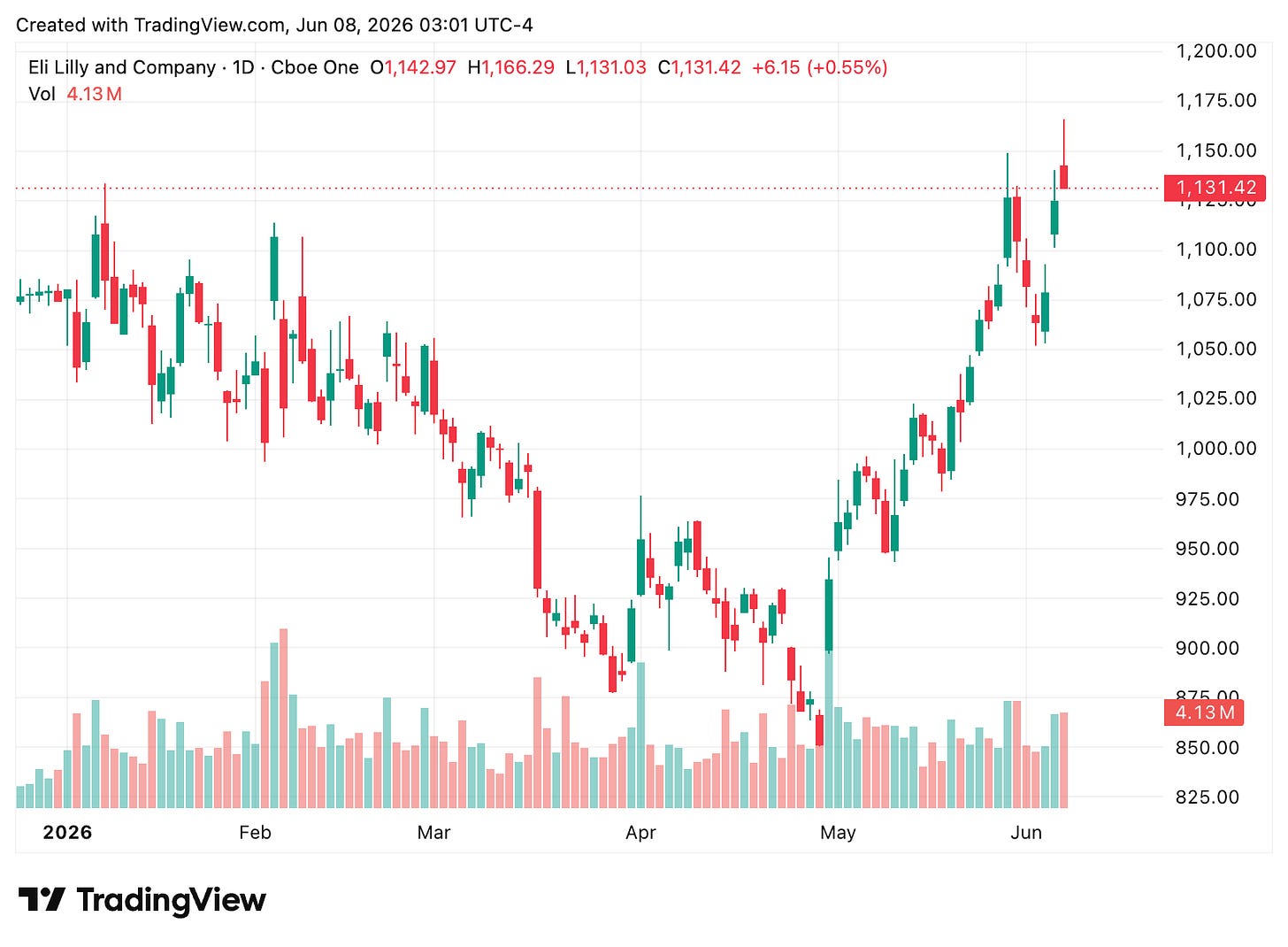
Three years later, on November 21, 2025, Eli Lilly became the first healthcare company in history to touch a $1 trillion market cap, an intraday cross that didn’t quite hold the close, but a milestone no drugmaker had ever reached. A stock that traded under $100 in 2018 would hit an all-time high of $1,149 by May 2026.
Created with TradingView
The distance between those two moments, humiliated by a fake “insulin is free” tweet, then crowned the world’s most valuable medicine company, is the story of this article.
It is partly a story about two molecules. But it is mostly a story about how a 150 year old Indianapolis institution deliberately rebuilt itself into “a brand people trust”, a phrase so central to Lilly’s own strategy that it became the literal headline of a trade-press profile of the company.
The trust foundation: heritage as an asset
Lilly was founded in 1876 by Colonel Eli Lilly, a pharmaceutical chemist and Union Army veteran, and has been headquartered in Indianapolis for all 150 years, a milestone it celebrated in May 2026. The family-founder-and-hometown narrative is not incidental; it is a deliberate trust signal.
The single most important heritage fact for the trust story is in 1923, where Lilly became the first company to mass produce insulin, launching the world’s first commercial insulin product, Iletin, after partnering with the University of Toronto researchers who discovered it. That heritage is double edged, it is exactly why the company’s later insulin pricing reckoning landed so hard.
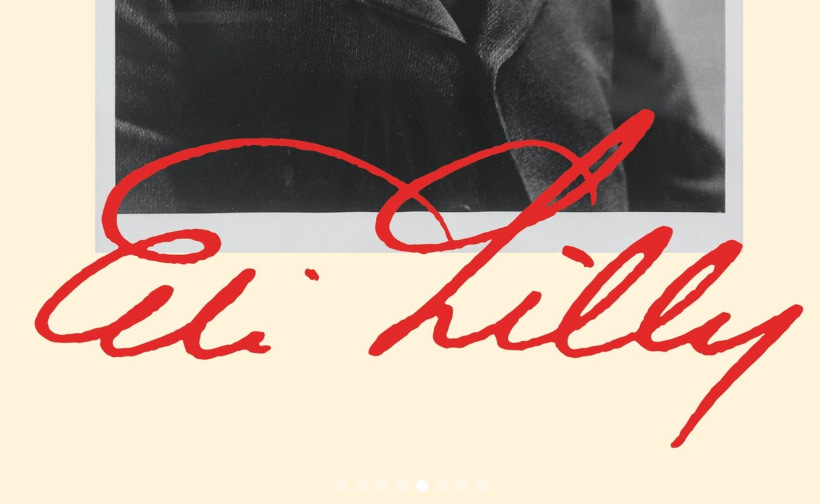
The cursive “Lilly” wordmark is the founder’s actual signature, not a lily flower. Colonel Lilly’s handwriting appeared on medicine bottles from 1876 and was standardized as the corporate emblem around 1906, after the Pure Food and Drug Act’s labeling rules. The mark turned red (Vivid Red, #D52B1E) around 2000. The “flower” association is purely etymological, the name traces to the Latin lilium.
The insulin moment that changed everything
If there’s one moment that anchors Lilly’s modern trust story, this is it. On March 1, 2023, Lilly announced it would slash insulin list prices by 70% and cap out-of-pocket costs at $35 a month. And these weren’t vague promises, the specifics were surprisingly concrete:
-
Humalog U-100 cut from $274.70 → $66.40 per 10mL vial
-
Humulin U-100 from $148.70 → $44.61
-
A new unbranded Insulin Lispro at $25/vial (May 1, 2023)
-
Rezvoglar at $92 per five pack, a 78% discount to Sanofi’s Lantus
-
A $35/month cap for the commercially insured, plus a savings card for the uninsured
CEO David Ricks framed it as a choice nobody forced on them: “We are doing this completely voluntarily because it’s time and it’s the right thing to do.” It’s a great line. But if we’re being honest with ourselves, we have to hold the warm feeling and the raised eyebrow at the same time.
Because here’s what the celebratory version of this story tends to leave out:
-
The federal Medicare $35 insulin cap took effect Jan 1, 2023 under the Inflation Reduction Act, two months before Lilly’s move. Lilly extended a cap to the commercially insured and uninsured, but it wasn’t acting in a vacuum.
-
Critics called it a “brilliant PR move.” Because most insured patients never paid list price, the headline “70%” overstates the real economic give.
-
A July 2023 Senate report found the $25 generic was unavailable at ~83% of surveyed pharmacies, calling the program “a public relations move.” Ricks called that “nonsense.”
-
Sanders responded by introducing a bill to cap insulin at $20/vial, “finish the job.”
So which is it, a genuine act of goodwill, or shrewd reputation management dressed up as generosity? That’s the tension at the heart of this whole story, and if you take nothing else from this piece, take this: it’s almost never one or the other. You’ll see this exact ambiguity show up again and again at every turn.
Did it actually work? (Mostly, yes)
The numbers say it largely paid off. The Axios Harris Poll caught a rare reputational bump for pharma in 2023, and it tied that bump explicitly to the insulin cuts, by the 2026 poll, Lilly ranked No. 13 out of 100. Fortune’s World’s Most Admired Companies list vaulted Lilly to #21 in 2025, up from #34. But before we declare victory, here’s the catch worth noticing: on the Access to Medicine Index 2024, Lilly came in a dismal 19th out of 20, strong on governance, weak on actually planning for access to its drugs.
So yes, trust got built, but unevenly, and depending on who you ask, you’ll hear a very different verdict.
Now the growth: the numbers that broke the ceiling
Here’s the thing, though: you can’t build a trusted brand on warm feelings alone. In pharma, trust ultimately lives or dies on whether the medicine works. So let’s talk about the medicine, because Lilly’s growth is genuinely staggering, and it’s concentrated in a way that’s worth sitting with.
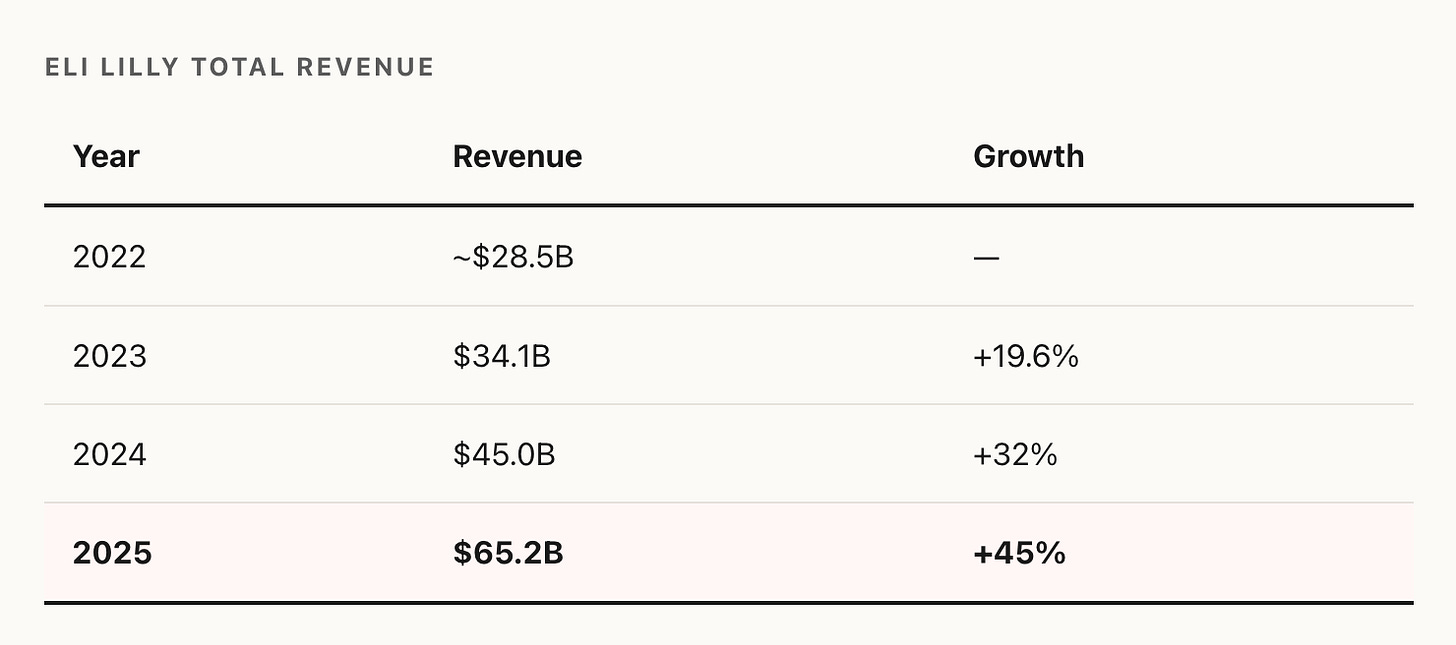
Consider FY2025 revenue of $65.2 billion, which beat the company’s own guidance at a time when most of Big Pharma was busy fighting off patent-cliff erosion (Merck up 1%, Pfizer down 2%). Then Q1 2026 came along and jumped a frankly absurd 56% year-over-year to $19.8 billion, which pushed Lilly to raise its full year guidance to $82–85 billion. Numbers like that don’t really happen in this industry.
And where’s it all coming from? Mostly two drugs. Mounjaro and Zepbound combined for roughly $36.5 billion in 2025, about 56% of all revenue, and the most valuable drug franchise in the world. Sit with that for a second: more than half of one of the planet’s biggest companies rides on essentially one idea.
One molecule wearing two hats
Here’s a neat bit of strategy worth understanding.
That whole engine runs on a single molecule, tirzepatide, a GIP/GLP-1 dual agonist, sold under two different brand names. It’s a textbook move: same drug, two doors. Mounjaro (for type 2 diabetes, launched 2022) booked $8.66 billion in Q1 2026 alone. Zepbound (for obesity, FDA-approved 2023) is where you really see the moat, though. In the head-to-head SURMOUNT-5 trial (NEJM, May 2025), Zepbound delivered 20.2% average weight loss versus 13.7% for Novo’s Wegovy, a 47% bigger result. It’s since picked up an obstructive sleep apnea indication and posted strong heart failure data from the SUMMIT trial. In plain terms, it doesn’t just sell well, it works better.
What’s next (and why it protects the whole thing)
A franchise this concentrated is also fragile unless you’ve got a deep bench. And Lilly does. Here’s the pipeline that keeps competitors up at night:
-
Orforglipron (brand: Foundayo): the first oral GLP-1 pill, FDA-approved April 1, 2026, taken any time without food or water restrictions. A small molecule is far easier to manufacture and distribute at scale than an injectable peptide, a structural edge rivals can’t easily match. Lilly built a ~$1.5B stockpile before launch.
-
Retatrutide: the “triple-G” agonist. TRIUMPH-1 showed up to 28.3% weight loss at 80 weeks (30.3% at 104), nearing bariatric-surgery territory.
-
Kisunla (donanemab): early Alzheimer’s, FDA-approved July 2, 2024, slowing decline ~35%.
-
Plus oncology (Verzenio, Jaypirca) and immunology (Taltz, Omvoh, Ebglyss): with 25-plus Phase 3 programs hitting positive topline in 2025 alone.
Building factories as both strategy and statement
On February 26, 2025, Lilly committed $27 billion to four new U.S. plants, pushing its total U.S. manufacturing investment since 2020 past $50 billion, what Ricks called “the largest pharmaceutical expansion investment in U.S. history.” Notice how this does double duty. On one hand, it’s a supply moat (remember, the 2022–2024 GLP-1 shortage was a demand problem, not a science one, they simply couldn’t make the stuff fast enough). On the other, it’s a deliberate wink at the reshoring-and-tariff politics of the moment. Smart companies rarely do just one thing at a time.
The brand machine: “Get Better” and the corporate halo
This is the part where trust and growth stop being separate threads and braid together. Around 2024, Lilly made a deliberate bet: lift the corporate brand up above the individual product brands. The work was led by Lina Polimeni, Chief Corporate Brand Officer, and built with agency Wieden+Kennedy Portland, and the master campaign, “Get Better”, launched in January 2024 during the NFL AFC Championship. Her thinking is worth understanding, because it explains so much of what follows: public perception had been “rooted in its products,” she argued, and trust in the corporate brand “carries over into the likeability of its more product-specific advertising.” Or, in her cleaner one-liner: “We’re not in the business of sickness, we’re in the business of health.”
The rebrand itself was thorough, a new custom monogram, warmer colors, fresh typefaces. But notice what they refused to touch: the founder’s-signature script stayed. That equity was simply too valuable to throw away, which tells you something about how seriously Lilly takes its own history.
The most fascinating move: ads that police its own drugs
Okay, this is the part I find genuinely clever. Lilly’s most distinctive habit is hijacking big mass-culture moments, the Oscars, the Grammys, the Olympics, to deliver unbranded trust messages, and sometimes even to police its own drug class. Watch what they’re doing here:
- Oscars 2024, “Big Night” & “Shame”: “Big Night” openly criticized celebrity off-label use “for the smaller dress or tux, for vanity… that’s not the point.” A manufacturer discouraging cosmetic use of its own blockbuster is almost unheard of.
- Oscars 2025, “Healthy Skepticism”: a swipe at unregulated compounded GLP-1s, ending on “Be a healthy skeptic.” A competitive threat, converted into a trust-and-safety message.
-
Grammys 2025, “Hands”: a breast-cancer early-detection film.
-
“My Focus”: “My body is nobody’s business but mine”, which drew backlash accusing Lilly of “promoting obesity as healthy.” Proof the strategy carries real risk.
And that’s just the splashy stuff. Underneath the big ads sits a deep owned-content operation: the Elixir Factor R&D podcast, a Chris Hemsworth Alzheimer’s collaboration, the Kisunla “Light Up Tomorrow” campaign (scored to a cover of “Here Comes the Sun”), and a multi-year Team USA / Olympics partnership (Paris 2024’s “One Body” spot reportedly racked up 519 million impressions). One quiet milestone deserves a callout: back in January 2019, Lilly became the first pharma company to put pricing information right in its DTC TV ads, a transparency signal that predates this whole “trust brand” era by years.
The disruption play: owning the patient relationship
Launched on January 4, 2024, LillyDirect is the company’s “tech playbook” move, a digital front door that pairs third party telehealth with direct-to-home delivery of Lilly medicines. Why does that matter? Because strategically, it cuts out the pharmacy benefit managers (the PBMs), the middlemen Ricks openly blames for “rent taking” and for driving insulin list prices “to $275.” In other words, Lilly is trying to deal with you directly instead of through the layers in between.
And the prices have been quietly marching downward, which is a transparency signal in its own right. Self pay Zepbound vial pricing fell from $399 / $549 (Aug 2024) to $299 / $399 (Dec 1, 2025). By Q2 2025, roughly 35% of new Zepbound prescriptions were running through the self pay option. An October 2025 Walmart Pharmacy partnership added retail pickup at the same prices, and a November 2025 deal with the Trump administration (TrumpRx) put Medicare beneficiaries at about $50 a month, with Ricks calling it “a pivotal moment in U.S. health care policy.”
Lilly voluntarily cuts prices, while opposing government-mandated pricing. The message: “We’ll lower prices ourselves, on our terms. Trust us, not a mandate.”
Why competitors can’t just catch up
Put it all together and you can see why this lead is so hard to close. Lilly is winning on efficacy (SURMOUNT-5 and TRIUMPH-1 both outclassed Novo’s CagriSema, which lost a head-to-head in Feb 2026 and sent Novo’s stock down about 16%). It’s winning on market share (its GLP-1 share climbed from 53% to roughly 57% across 2025, while Novo’s stock got cut in half). And it’s winning on structure, the oral pill plus $50B+ in U.S. manufacturing are the kind of moats that take late entrants like Pfizer, Amgen, Viking, and Roche years to match. For context, analysts peg the obesity market at $95–150 billion by 2030. This isn’t a small prize.
Now the part the victory lap skips
I don’t want to leave you with a tidy fairy tale, because the threats to this trust narrative are real and well documented. So let’s be fair and look at the cracks:
-
The “virtual pill mill” investigation: Senators Durbin, Sanders, Warren and Welch probed LillyDirect’s tied-telehealth model, where partners prescribed to ~74% of routed patients, alleging conflict-of-interest. The channel that signals “trust and access” is also the one drawing the sharpest ethics scrutiny.
-
Litigation everywhere: Lilly has sued dozens of compounders and telehealth firms (framed as patient safety), while a Texas AG suit (Aug 2025) accuses Lilly of “bribing” prescribers, which Lilly denies.
-
The DEI walk-back: Lilly stripped DEI and “racial justice” language from its 2025 proxy amid political pressure, a reversal that sits awkwardly against its “health equity” messaging.
-
The stigma backlash: “My Focus” shows the anti-stigma line can read as “Lilly profits from obesity drugs while telling us obesity is fine.”
-
Insulin skepticism never fully died: advocates still note U.S. insulin costs more than three times what it does in other countries.
So what do we actually make of all this?
Once you’ve seen the whole picture, Lilly’s playbook gets surprisingly easy to read. It rests on four pillars, and it’s worth knowing them because you’ll start spotting versions of this everywhere:
-
A corporate halo (“Get Better,” the founder’s-signature heritage) that lifts every product beneath it.
-
Anti-stigma, “health-not-appearance” messaging that reframes its highest-revenue category as legitimate disease treatment.
-
Science-and-safety positioning that attacks vanity use and counterfeits, turning threats into trust.
-
Access signaling insulin caps, price transparency since 2019, LillyDirect, that claims the affordability high ground while fighting government price setting.
If I had to boil it down to one honest sentence, it’d be this: Lilly built genuine trust on the back of genuine results. The drugs really do work better than the competition’s, the factories are real, the price cuts are real, even if the timing was strategic and the brand work is about as sophisticated as anything in any industry. But (and you knew there’d be a but) that trust is also carefully managed, and the very same moves that earn it happen to double as competitive weapons and revenue protection. Both things are true at once. That’s the whole point.
Which brings us back to that fake “insulin is free” tweet. It went viral in 2022 precisely because it was believable, of course people wanted to believe a drug company would do the right thing, and of course they assumed it wouldn’t. Lilly’s real achievement is that three years and a trillion-dollar valuation later, that same underlying claim, this is a company that puts patients first, is something millions of people now actually believe.
Whether that belief lasts comes down to one simple test: do the results, and the price cuts, keep coming? Ask me again in a few years.

