I have no biology background and I can't stop reading about it
Let me be upfront about something before we go any further. I have never worked in the biotech or pharma. I have no background in medicine beyond what a curious person picks up over a lifetime of reading. I do not hold shares in any drug company, have no consulting relationship with any research institution, and no one is paying me to have opinions about AlphaFold or clinical trial design.
I am, by any reasonable definition, an outsider.
What I can offer is the perspective of someone who came to this field genuinely curious, with no axe to grind (someone who reads widely, forms actual opinions, and is willing to make predictions and be wrong about them in public). I think that has some value in a space where most coverage comes either from insiders protecting their own interests or journalists parachuting in for a single story.
How AI changed what I read
AI did not just give me new tools. It gave me a new set of questions and some of the most interesting ones turned out to live in fields I had never thought to look at before. One of those fields was drug discovery.
And if you needed a single data point to show you this is no longer a niche story: last week, Anthropic paid $400 million to acquire a 9 person biotech startup. A company with no public product, no disclosed revenue, and barely 8 months of existence. That’s how seriously the biggest AI labs in the world are now betting on this space.
Because here is what I found when I started reading seriously → the pharmaceutical industry has one of the most important jobs in human civilization: finding new medicines and it is almost absurdly bad at it. Not for lack of trying. Not for lack of money. The biology is just genuinely, brutally hard.
And AI, for the first time in a long time, looks like something that might actually change the odds.
Drug discovery is broken. Here’s how broken
I want you to sit with a few numbers before we go any further, because until you feel them properly, none of the AI stuff makes sense.
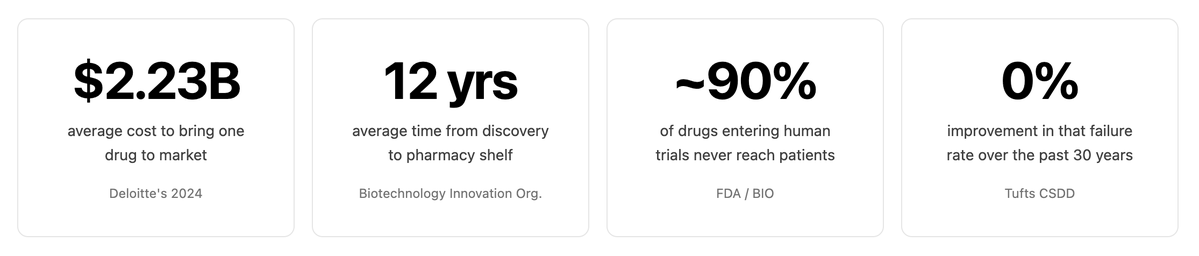
Nobody agrees on exactly how much it costs to develop a drug, estimates range from $900 million to $2.3 billion depending on who’s counting and how. But everyone agrees on the direction: it’s expensive, it’s getting more expensive, and the returns are shrinking.
-
Deloitte’s 2024 analysis of 20 major pharma companies found the average development cost hit $2.23 billion while the average projected peak sales per drug fell to just $510 million. Do the math.
-
It takes around 12 years from discovery to pharmacy shelf. And roughly 90% of drugs that enter human clinical trials never reach patients. Nine out of ten.
-
That last one is the one that gets me. The failure rate hasn’t moved.
We have better technology, more data, more compute, a deeper understanding of the genome than anyone could have imagined in 1990 and nine out of ten drugs that enter human clinical trials still fail. The average trial duration actually increased between 2008 and 2018, with no corresponding improvement in outcomes.
This is not a funding problem. The pharmaceutical industry spends more on R&D than almost any sector on earth. It is a search problem. Finding a molecule that does exactly what you want to a specific protein inside a human body without causing harm, without getting broken down too fast, without failing in any of a hundred other ways, is searingly difficult.
The space of possible drug-like molecules is estimated at somewhere between 10²³ and 10⁶⁰ compounds. That is not a typo. Traditional drug discovery can explore a vanishingly small corner of it.
That’s the problem. That’s what everyone has been stuck on for 50 years.
Here’s the part I couldn’t look away from
I know how that sounds. “AI will fix it” has been promised before and it hasn’t. One pharma CEO said it plainly not long ago:
“AI has really let us all down in drug discovery. We’ve just seen failure after failure.”
That’s a real quote from someone inside the industry, not a critic. So I held that skepticism for a while. Then I read about rentosertib.
In 2025, a drug designed entirely by AI, not assisted by AI, not optimized by AI, but conceived by it from scratch, target and molecule both, completed a clinical trial and published positive results in Nature Medicine. The disease was idiopathic pulmonary fibrosis, a brutal lung condition with no cure. The drug worked.
The part that broke my brain wasn’t that it worked. It was how fast. Thirty months from “what should we target?” to human clinical trial. The normal timeline for that is six to eight years.
I kept waiting for the catch. I’m still waiting.
Now there are 173 AI-discovered drugs in clinical development. Three years ago there were 67. Three years before that, there were barely any. Something is clearly happening even if we don’t fully know yet whether it holds up at the finish line.
That’s the honest position. Early signals are genuinely exciting. The final proof of Phase III data, regulatory approval, a drug on a shelf that AI made hasn’t arrived yet. But it’s closer than it’s ever been. And the people writing $400 million checks for nine-person biotech startups seem to think the wait won’t be long.
What I actually think is happening
My read is that, we are not at the beginning of AI in pharma. We are at the end of the beginning. The proof-of-concept phase is closing. What comes next is the part where it either compounds into something that reshapes the entire industry, or stalls out at the edges and becomes another expensive tool that didn’t quite deliver on its promise.
I think it compounds:
-
I think drug discovery has always been a data and compute problem wearing a biology costume. The biology is real and hard I’m not dismissing it. But the reason the search has been so slow, so expensive, so prone to failure, is that humans are genuinely bad at navigating spaces of 10⁶⁰ possibilities. We weren’t built for it. AI was.
-
What generative models bring to this problem isn’t just speed. It’s a fundamentally different relationship with the search space. Instead of screening what exists, you design what should exist. That’s a category shift, not an incremental improvement. And category shifts in how you find things tend to compound fast once they get traction.
-
The VC money already figured this out. AI drug discovery funding has gone from a niche bet to one of the most competitive areas in life sciences investment. Isomorphic Labs raised $600 million in 2025. Xaira Therapeutics launched with over $1 billion. Chai Discovery raised $130 million for a generative platform. These aren’t small follow-on rounds, they’re conviction bets from people who have seen the early data and decided the category is real.
-
And then Anthropic acquired a coefficient bio for $400 million. That tells you something important about where the frontier labs think the next decade of AI value actually lives.
My predictions and I’ll be wrong about some/all of these
-
At least one high-profile AI drug fails Phase III and the headlines will be brutal. “AI hype crashes.” “Billions wasted.” The usual. Ignore it. One failure doesn’t break the thesis, it just burns off the people who were never serious about it.
-
The first AI-discovered drug gets approved by end of 2027. I think it’s more likely than not.
-
Within 3 years, every major pharma company either acquires an AI-native biotech outright or builds one internally from scratch. Partnerships and API access are already starting to feel insufficient. The companies that understand this early get a pipeline advantage that is very hard to close later.
-
Central nervous system is the final boss. Alzheimer’s, depression, schizophrenia remains the last frontier, the diseases that have humiliated every generation of drug hunters, AI won’t crack these by 2030. The biology is harder, the trial design is harder, the failure rate is higher than anywhere else in pharma.
-
The biggest wildcard and this is the one I think about most, is data. Right now, every pharma company is sitting on proprietary biological datasets that no AI platform has access to. The company or consortium that figures out how to pool that data, even partially, even through federated approaches that preserve IP, gets an asymmetric advantage that compounds every year. Whoever solves the data problem probably wins the whole thing.
If you work in this space and I get something wrong, please tell me. That’s the point.
Let’s go.
Footnote
I started following this space because AI led me to it. I stayed because I couldn’t stop thinking about the problem.
There is something genuinely strange about the fact that we can put a computer in everyone’s pocket, sequence the human genome, and land a rover on Mars and we still can’t reliably find medicines that work. Not for lack of trying. Not for lack of money or intelligence or effort. The biology is just that hard.
What AI is doing to this problem, slowly, imperfectly, with real failures along the way is giving researchers a fundamentally better way to search. Not a guarantee. Not a shortcut. A better search.
If that compounds over the next decade the way I think it will, some of the diseases that feel permanent right now won’t be. That’s not hype. That’s just what happens when you point a genuinely new tool at a genuinely hard problem and give it enough time.
I’m not an expert. I’m just someone who found this too interesting to look away from.
I’ll be back.